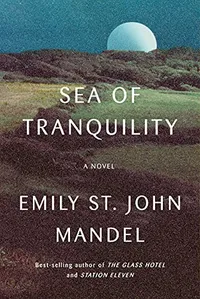
Sea of Tranquility
Okay, so the book was way better than I expected. Whenever I wasn’t reading it, I kept thinking about the plot and how all the stories would tie together by the end.
It’s a sci-fi novel whose action is divided across four different time periods: 1912, 2020, 2203, and 2401. All these moments end up connected by an event that cannot be explained—or perhaps by a certain person who causes that event to happen.
This event, experienced by multiple people at the same time but in different centuries, ends up being investigated by a detective from the Time Institute, sparking a debate: are we living in a simulation and this is a glitch, or is it some kind of natural anomaly?
1912
The book’s action begins in 1912 with Edwin St. John St. Andrew (yes, the name structure mirrors the author’s, Emily St. John Mandel) who is sent into exile in Canada after an argument with his father in which he dared to criticize the British Empire’s intrusiveness in India—and pretty much everywhere else in the world up to that point.
Edwin has a very calm nature. He takes the exile as an opportunity and a new experience. And once he arrives in Halifax, Canada, he’s in no hurry to go anywhere.
He learns to paint, spends time by the sea, reads—he’s not driven by the interests of other Brits who come to Canada trying to build an empire or start some business.
Eventually he heads to Victoria, British Columbia, and from there he’s set to reach Vancouver Island, where, incidentally, our story starts to make some sense. 😅
One of the days when he was doing nothing, he went for a walk on the island’s beach where he meets two Native locals.
As he walked toward them, he kept running scenarios in his head: what if he struck up a conversation with them, what if he mentioned that he disagreed with how the British Empire had forced its way into certain regions and that he was exiled here precisely because he’d said as much, and so on.
He thought so much about what to say that the moment passed, and you get that feeling of having missed your chance to speak and now you have to move on so the situation doesn’t get awkward. This feeling was portrayed really well.
After leaving as if he had business further down the beach, he deliberately changes direction toward the forest at the edge of the beach (still to give the two women the impression that he knew where he was going and actually had something to do).
In the forest, he briefly encounters a priest or someone dressed as a priest, moves on, and reaches a tree where, for a fraction of a second, he has a sensory experience he cannot explain:
- everything goes dark
- he hears a violin
- he hears an indescribable sound and the noise of a crowded train station
2020
The next period in the book jumps to 2020, where we “see” a video recorded by Vincent somewhere in 1990 when he was a child. The video starts with him walking through the same seaside forest and seems to be heading straight to the spot where, almost 100 years earlier, Edwin had an inexplicable experience.
The recording turns to a black screen for a moment, and for a fraction of a second, the same things are heard: a violin, an unclear sound that might be a powerful whoosh, and the noise of a crowd.
2203
Another time jump and it’s 2203, with Olive on a book tour on Earth. By this point, we already have colonies on the Moon.
Her book, Marienbad, becomes very popular after being adapted into a TV show, so she’s on this tour giving promotional interviews.
Often, excerpts from the book are presented, and audience questions make her reflect on both the book and real life.
Olive’s sections contain quite a few philosophical ideas.
For example, her book features the death of a prophet, presented in a very telegraphic manner, without much fuss. One of the audience questions refers to this: how the event was so easily glossed over in the book. But isn’t the death of the prophet just like the death of any of us, in the end? A normal, mundane event, seen from the outside. Why would it deserve more attention in a larger context?
Back to our book’s story, what matters is that in her book there’s this image of a character in a spaceport terminal where a violinist plays, and in the background you can hear the noise of the crowd and departing ships.
Yup, the same image as the other two, just from a different perspective.
In one of her interviews on Earth, the second-to-last one, the person she talks to is a certain Gaspery-Jacques—the same name as one of the characters in her book.
2401
In 2401, we meet Gaspery-Jacques, who indeed is the same person as the interviewer from 2020.
Gaspery-Jacques is the detective who ends up time-traveling to try to identify the source of that anomaly that spanned multiple centuries, affecting several people at the same time.
Gaspery’s story is really cool; he’s a very likable character. Unbeknownst to him, he has a cat from 1900—that’s a whole other story, but it’s only hinted at.
Gaspery was named that by his mother, who was a fan of Olive’s book Marienbad. There’s a constant theme of self-fulfilling prophecy in the book.
In 2401, we learn about time travel, about detectives sent to different eras to investigate things, but all of this is secondary to Gaspery’s story. His character is very well-developed, which is probably why he becomes so likable.
I won’t go into details, because it would take me all day and I still wouldn’t cover all the details in the book. It’s about 260 pages long, and you realize there’s layer upon layer of story you haven’t unpacked yet.
Gaspery travels back in time to all the aforementioned moments to interact with the characters and figure out how and why that anomaly occurred, trying to determine whether it’s something natural or if we’re actually living in a simulation that had a glitch, an error, at that moment.
From this point on, the book jumps between centuries, but now with him present. This helps complete the narrative thread of those early chapters.
Ending
I’ll jump straight to the end.
Gaspery does the one thing forbidden for a time traveler: he tries and succeeds in changing the course of Olive’s life, who was supposed to die in a pandemic (yup, the book was written during COVID-19).
The punishment he receives is to be abandoned in time, in a different era. And we have the self-fulfilling prophecy, tied to the story where a character from 1990 sees Gaspery under a walkway with a gun in hand as he’s being arrested.
Even this part deserves further comment, which is why I say there’s so much in a 260-page book. Why bother bringing time travelers who altered the past back to the present and locking them up there, when you can frame them for a crime in another era and leave them imprisoned there?
But it doesn’t end with his arrest.
Gaspery, transported through time from prison by his sister, ends up in 2172, in Oklahoma, in this new place where he’s supposed to be safe with a new identity.
His new identity? Alan Sami.
The violinist from the terminal! The one that a younger version of Gaspery interviews.
A life lived in a simulation is still a life.
A few more things I noted:
- Even though it’s 2210, whenever Olive talks to men and says she writes books, they all seem to make misogynistic or sexist comments. Like, children’s books? Or, you’re lucky your husband agrees to stay home with your child while you’re on tour. (As if it’s only her child.) Somehow, these parts seem to me like the author wants to highlight a real issue in our days, but I would have expected that 200 years later it wouldn’t be such a present problem. Or maybe we’ll never get rid of it.
- Olive makes an interesting remark: as a civilization, as organisms, as people, we always want to believe we’re living at the peak, that our problems are the real ones, that things are worse now than ever and danger is imminent, that it’s only happening to us. Somehow, we don’t conceive that previous or future generations experienced something just as serious or dangerous for their time. A kind of civilizational egoism.
Note: I wanted to watch Station Eleven, the TV show, and now I found out it’s based on a book by Emily St. John Mandel.
Is there a connection between the character Olive and the book’s author? Maybe.