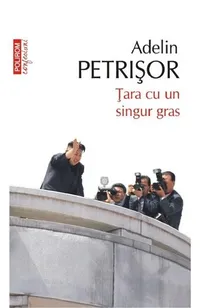
Țara cu un singur gras
Adelin Petrișor, probably the best-known Romanian reporter, makes his way to North Korea in 2012, the year Kim Jong Un came to power, to shoot a documentary about the regime there.
It’s a short book that works as a companion piece to the video documentary he made while he was there: North Korea, Nothing to Envy, a documentary by Adelin Petrișor
We learn that getting into North Korea is not as simple as it might seem, not even if you’re Adelin Petrișor.
It takes a lot of phone calls, persistence, and a stroke of luck, because otherwise you don’t get the invitation to fly from China to North Korea, the only way to reach Pyongyang.
The invitation came right around the “coronation” of Kim Jong Un, the moment he was presented to the whole world. That year, several Western publications were granted access to North Korea to film and even broadcast live from there.
The book flows very easily: Adelin tells the story in a conversational, “spoken” style, and the interactions between him, the cameraman, and their guide Ri are quite direct at times, without too much beating around the bush. Perhaps a bit too much unfiltered humor and directness, if you consider how the guide avoids answering certain questions.
Their experience there was a controlled, sanitized one, always with the guide in tow. They weren’t allowed to leave the hotel except when something was on the schedule; the rest of the time they stayed in this hotel reserved for foreigners, which more than likely was bugged. Contact with the outside world, back home, was only possible from a few dedicated phone booths where you’d ask to be connected to someone, like an old-fashioned telephone exchange with an operator.
Even with an experience sanitized to this extent, you still can’t hide everything. The atrocious-looking neighborhoods where you’re immediately warned that filming is not allowed, the soldiers mopping water off the pavement with rags while waiting for the leader’s arrival, the exhausted people taking part in the choreographed events, the soldiers literally asleep on their chairs in the stadium while speeches are delivered from the podium, the people who are scared and keep their distance from foreign reporters (reporters who are required to wear an armband so they’re easy to spot).
All of these things come through in the book, but also in the video footage: this whole charade of megalomania and dictatorship in which millions of people are prisoners and don’t seem able to do anything about it.
Adelin compares his experience in North Korea with what Romania could have become at some point had it not had its revolution in 1989. And you can certainly see the similarities: all the celebrations and festivities dedicated to the leader that also appeared in Romania after Ceaușescu’s visit to North Korea are mirrored one-to-one with what he saw there at the time, and are the same ones Adelin sees in 2012.
Only the leader has changed and a few new statues have appeared, but nothing else seems any different there.
Below are a few quotes I saved.
I had read that, in fact, their money is worth next to nothing and that on the black market foreign currency is preferred. In any case, foreigners weren’t allowed to hold won and were required to pay only in dollars, euros, or yuan, the Chinese currency. Besides, in a whole week I didn’t manage to see even a single North Korean banknote, even though I had asked for one.
About the shop on the ground floor of the hotel meant for foreigners:
Compared to any 24-hour corner store in any working-class neighborhood in Romania, I can say hand on heart that the shop was a dump. It was, however, one of the best in the city, and out of reach for ordinary people.
I was stunned when Ri casually explained to me that you need approval to travel to the provinces, to visit relatives. On the principle that you can’t just go wherever you please.
In his attempts to interview North Korean citizens out on the street or at the festivities:
After each interview on the street, Ri would linger with the person for a bit and jot down their full name. […] Sometimes, after speaking briefly with the person I had approached, he would turn around and tell me only: “That’s not what you need.”
At midnight, absolutely all the streetlights go out to save power. Well, not quite all of them. The statues of the leaders stay lit. How else?
Description
This description is grabbed from Google Books or GoodreadsȚara cu un singur gras ("The Land with a Single Fat Man") recounts Adelin Petrișor's 2012 visit to Pyongyang together with another journalist, the first Romanians allowed into North Korea since 1989, and their attempt to capture as much as possible of the everyday reality of this isolated country, at the cost of some unpleasant incidents.
With 16 of the color photographs illustrating the book, Petrișor took part in the International Photography Awards, winning the prize in the "Editorial Non-Pro" section and reaching the finals of "Discovery of the Year". A direct, human account of a closed world, a starved dystopia of ideological absurdity with a nuclear bomb.